



Colleges  University of Toronto
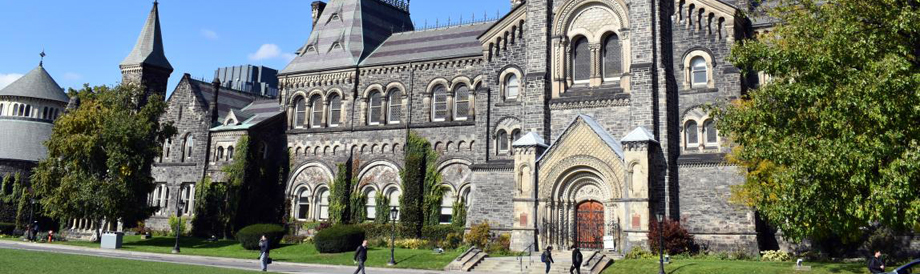
|
University of Toronto |
 |
| location | students | adm. | int’l. | fresh | grad | GPA | ACT | SAT | TOEFL |
| Toronto, ON | 99,794 | 43% | 30% | 93% | 80% | 3.7 | 26 | 1240 | 100 |
The University of Toronto (U of T) is a public institution that was founded by royal charter in 1827 as King’s College, the first institution of higher learning in Upper Canada. U of T has three campuses: Mississauga, St. George, and Scarborough. Its main campus, St. George, is the oldest of the three and located on the grounds that surround Queen’s Park in Downtown Toronto. The University is the largest in Canada with nearly 100,000 students across its three campuses, with typically 80% studying at the undergraduate level. Thousands of foreign students from more than 178 countries and regions attend U of T. There are over 1,200 student clubs, organizations, and activities across all three campuses. Student housing is available on each campus, and accommodations are guaranteed for all first-year undergraduates. The University’s library system is Canada’s largest research library system, and second largest in North America.
 Academics
The University of Toronto receives the most annual scientific research funding and endowment of any Canadian university. It is also one of two members of the Association of American Universities outside the United States, alongside McGill University in Montreal. The University comprises academic divisions focused on a range of disciplines: applied science and engineering, management, and public health. U of T offers over 700 undergraduate programs in Humanities & Social Sciences, Life Sciences, Physical & Mathematical Sciences, Commerce & Management, Computer Science, Engineering, Kinesiology & Physical Education, Music, and Architecture, Landscape & Design. It also offers more than 200 masters and doctoral programs in a wide variety of fields including Education, Nursing, Dentistry, Pharmacy, Law and Medicine. The student-faculty ratio at University of Toronto is 15:1. Popular majors include Life Sciences, Commerce & Management, Economics, and Political Science.
 Special Highlights
Hart House. A notable hub for social, cultural, and recreational activities at the University of Toronto is Hart House, a neo-Gothic student activity. Opened in 1919, the complex aimed to establish a communitarian student culture in the university and its students, who at the time kept largely within their own colleges under the decentralized collegiate system. The Hart House offers a range of services and facilities, including a library, restaurants, barbershops, an art gallery, a theatre, concerts, debates, study spaces, and a swimming pool. The confluence of assorted functions is the result of an effort to create a holistic educational experience. The Hart House model was influential in the planning of student centres at other universities, notably Cornell University’s Willard Straight Hall in Ithaca, New York.
Philosopher’s Walk. Philosopher’s Walk is a scenic footpath located along the St. George campus of the University of Toronto. It runs in the north-south direction along the ravine landscape created by Taddle Creek, once a natural waterway that was buried during the Industrial Age and is now flowing underground. The path is bounded by several Toronto landmarks, including the Royal Ontario Museum, the Royal Conservatory of Music, Trinity College, the University of Toronto Faculty of Music, and the University of Toronto Faculty of Law. Philosopher’s Walk links the heart of the university campus to the northern edge bounding The Annex, an academic neighborhood where many of the university’s faculty and student body reside.
 School Mission & Unique Qualities
Unlike many North American institutions, the University of Toronto is a collegiate university with a model that resembles those of Cambridge and Oxford in Britain, comprising 11 colleges, each with substantial autonomy on financial and institutional affairs and significant differences in character and history. UToronto was the birthplace of insulin, stem cell research, the first artificial cardiac pacemaker, and the site of the first successful lung transplant and nerve transplant. It was also home to the first electron microscope, the development of deep learning, neural network, multi-touch technology, the identification of the first black hole Cygnus X-1, and the development of the theory of NP-completeness. The University is also noteworthy for receiving both the single largest philanthropic gift and research grant in Canada, and is among the top in the world for entrepreneurship and business incubation.
 Student Reviews…
“The campus is beautiful, the students are smart and passionate, and there are plenty of opportunities to socialize if you step out of your comfort zone. I learned a great deal here. It teaches you how to work hard, how to learn things for yourself, and how to recover when things go wrong. It’s not perfect, but it is an experience that changes you for the better.”
