



Colleges  McMaster University
|
McMaster University |
 |
| location | students | adm. | int’l. | fresh | grad | GPA | ACT | SAT | TOEFL |
| Hamilton, ON | 37,537 | 44% | 17% | 92% | 79% | 3.5 | 27 | 1200 | 88+ |
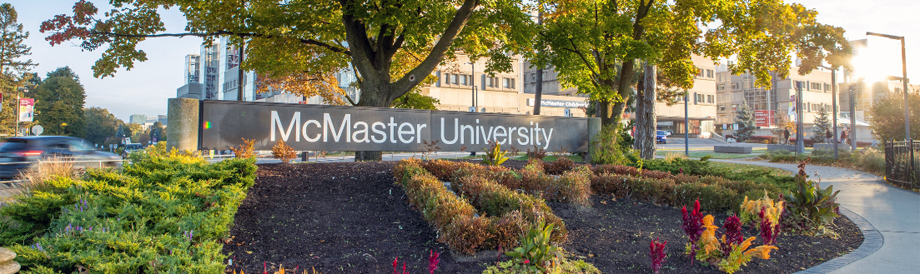
McMaster University is a public institution that was founded in 1887. The Canadian university’s main campus is on a 300-acre campus in the suburban neighborhood of Hamilton, Ontario, near the western edge of Lake Ontario and not far from the US border. A one-hour drive from Toronto and a one-hour flight from major American hubs New York City, Washington D.C and Chicago, the campus is located in the heart of one of the most vibrant, innovative and multicultural regions of North America. Other campuses are located in downtown Hamilton, Burlington, Kitchener-Waterloo, and Niagara. The university’s primary language of instruction is English. International students hail from more than 75 countries, and its full-time faculty members come from more than 55. University-operated student housing is available, with options including themed living communities such as an all-female community, a healthy active living community, and a global perspectives community.
 Academics
McMaster University has six main academic divisions: engineering, health sciences, humanities, science, social sciences, and the DeGroote School of Business. There’s also an arts and science program that enrolls around 60 students each year and offers a more interdisciplinary undergraduate experience. The academic calendar for McMaster undergraduates is semester-based and includes an optional spring/summer term. The graduate-level academic calendar has three terms: fall, winter and summer. Recognized as one of Canada’s top three research-intensive universities, McMaster features more than 70 centres and institutes including three national Centres of Excellence: Centre for Health Economics and Policy Analysis, the McMaster eBusiness Research Centre, and the Canadian Centre for Electron Microscopy. The student-faculty ratio at McMaster University is 27:1. Popular majors include Health Sciences, Engineering, Business, and Computer Science.
 Special Highlights
MODEL. The McMaster Office for the Development of English Language Learners (MODEL) is a free service designed for both undergraduate and graduate students who may need help with studying and living in an English-language environment. MODEL offers English-language training, workshops, and support, developed by certified ESL and EAP experts, to meet the needs of McMaster students of all academic backgrounds and levels of English language proficiency. MODEL also has an on-site student advisor with experience in both ESL and counselling who is available to meet with students to discuss personal, social, and academic concerns. In addition, McMaster offers workshops with a focus on acculturation and academic skills, helping ESL students feel comfortable with new cultural and social scenarios.
Community Engagement. Community engagement at McMaster involves performing research, teaching and service for or with community members and partners for the public good. Community-engaged education at McMaster aims to provide students with the opportunity to integrate their academic knowledge with experiences in the community to address social, economic, environmental, and health concerns. Community-engaged education is a type of experiential education that enables students to learn from and give to communities, and can occur both within a course or a co-curricular experience. The Student Ambassadors group, comprising undergraduate students from various faculties, collaboratively executes promotional campaigns, co-creates projects addressing real-world challenges, and implements social programming to strengthen relationships among the McMaster community.
 School Mission & Unique Qualities
McMaster’s location of Hamilton, Ontario features more than 100 waterfalls within city limits. The university campus is a short walk from the Niagara Escarpment (a UNESCO World Biosphere Reserve), the waterfront trail, the Royal Botanical Gardens, Lake Ontario, and the Cootes Paradise nature reserve, a large and beautifully maintained waterway. McMaster is the home of problem-based learning—its signature teaching method. Pioneered at McMaster and adopted by institutions around the world, this innovative approach opens young minds to new ideas and hones the critical thinking skills needed to create healthy communities in a complex and changing world. An interesting fact about the university is that one-fifth of Albert Einstein’s brain sits in a jar in one of the school’s labs where a McMaster neuroscientist studies it and other specimens. McMaster also has its own nuclear reactor, which is used for research.
 Student Reviews…
“What I’ve loved most about McMaster is the sense of community, collaborative environment, and connecting with people from diverse backgrounds. The support from faculty and available resources have empowered to pursue my goals. However, I believe there is room for more hands-on learning opportunities, especially within the first year, to better prepare students.”
